Writing a good birthday card is a small skill. Most people default to "Happy birthday! Hope you have a lovely day!" and call it done. Which is fine - no one is offended by the default. But the card they actually remember five years later is the one that named something specific.
This is a short, honest guide to writing one.
The three-part formula
Every good personalised birthday card has three beats:
- Something specific about them - a quality, a memory, a thing they did.
- A bit of warmth - genuine, not flowery.
- A sign-off that matches your relationship - formal, funny, plain, whatever fits.
That's it. If your card has those three things and a real signature, it will beat any supermarket card.
Example: a card to your best friend
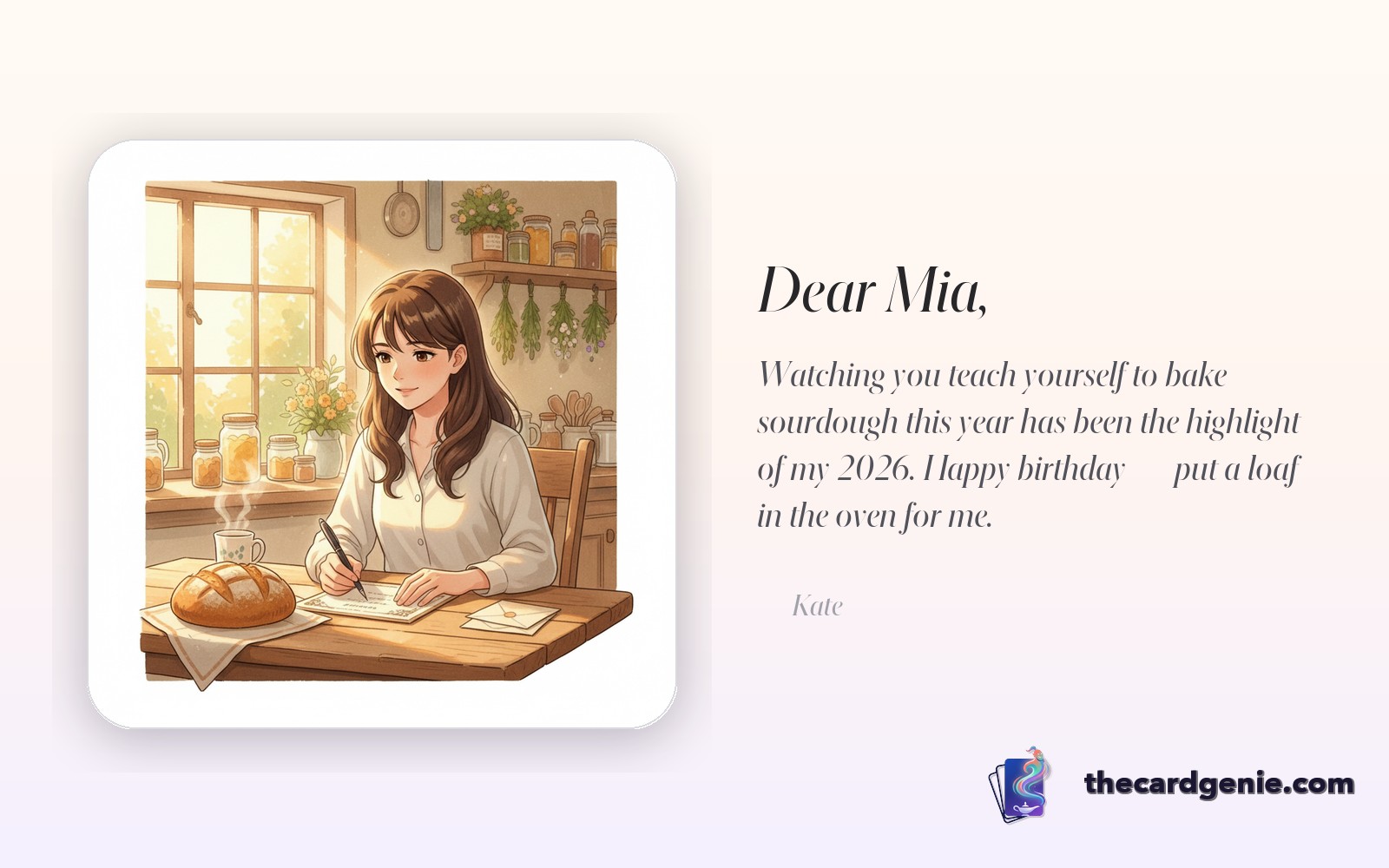
Specific thing: "Watching you teach yourself to bake sourdough this year has been the highlight of my 2026 so far."
Warmth: "You commit to things in a way that I always find a bit inspiring."
Sign-off: "Happy birthday. Put a loaf in the oven for me."
Three sentences. Done. Stronger than a page of "hope you have a lovely year!"
Example: a card to your mum
Specific thing: "I don't know how you still make the flat feel like a home when we're all round for Sunday lunch."
Warmth: "You've been doing that for thirty-five years without anyone thanking you for it properly."
Sign-off: "Happy birthday, mum. Thank you."
Example: a card to your partner
Specific thing: "This year has had more in it than most. You've held every hard bit without fuss."
Warmth: "You're the version of calm I didn't know I was looking for."
Sign-off: "Happy birthday, love. Dinner's on me."
Writing by relationship
The three-part formula stays the same, but the tone shifts. A few worked examples.
Writing to a parent
Parents will read the card twice. Once in the moment, once alone later. Write for the second reading. Don't pile in jokes that work across a dinner table; those get lost on a second read. Do name a specific thing you noticed them doing this year.
"You've been looking after everyone else for a long time, including the grandkids, including dad, including me when I wouldn't admit I needed it. Happy birthday. Take a weekend off and we'll sort the rest."
Writing to a sibling
Siblings respond to specifics only siblings would know. Lean into the shared history - the family trip, the row at Christmas, the thing your mum still brings up. Warmth comes through the in-jokes, not despite them.
"Another year of you being annoyingly the favourite. Happy birthday - you deserve the favouritism, I'll admit it in writing once a year."
Writing to a partner
Partner cards are the ones most people overthink. The trap is grandness - sweeping phrases about forever that they've already heard from you in other contexts. The better move is something small and specific: a moment from the past year, a private phrase only you two use.
"This year you got me through the thing I couldn't say out loud. You knew anyway, which is the thing I love most about you. Happy birthday, love."
Writing to a close friend
Friends want to be roasted, but warmly. Half-praise, half-piss-take works well here. It tells them you see them clearly and still like them anyway, which is the whole definition of friendship.
"Happy birthday to someone who has seen me at my absolute worst, forgiven it, and then mentioned it at every subsequent birthday. I wouldn't have it any other way."
Writing to a colleague
Work cards have a lower ceiling but a very clear floor. Keep it warm, name one professional strength, don't be weird. If it's a team card that everyone's signing, a specific line about one thing beats the default "Happy birthday!" signature.
"Happy birthday - thank you for being the person who actually reads the briefs. It's noticed."
Writing to a child
Kids reread their birthday cards for weeks. Write for ten-year-old-them re-reading it in a drawer. Short, specific, kind.
"Happy birthday, little one. You made us laugh three times this morning already. Keep going."
Writing to an older relative
For grandparents and older aunts/uncles, handwriting still matters most. Keep language classic - they're a generation that writes letters and will notice flippancy. Name something specific they taught you. Thank them without performing it.
"Happy birthday, Nan. Thank you for teaching me the right way to make a pot of tea. I still do it your way, every time."
A worked example - bad to good
Sometimes the easiest way to show the difference is to edit the same card twice.
Draft (generic): "Happy birthday to the best mum in the world! Hope you have an amazing day and that this year is full of happiness, love and laughter. Thanks for everything you do!"
Says nothing. Could be to anyone's mum. Three worn phrases ("amazing day," "happiness love and laughter," "everything you do") that have lost all meaning.
Second draft (specific): "Happy birthday, mum. This year you talked me down from that job decision at 11pm on a Tuesday. I don't say it enough - you're the person I actually listen to. Thank you."
Same length. Infinitely stronger because it names a specific thing only this mum could have done. That's the whole move: swap the generic for the specific, everywhere you can.
What to avoid
- Generic abundance: "Wishing you happiness, health, love, laughter, wealth and joy!" - says nothing.
- Third-person weirdness: "May this year bring you…" - fine for a Hallmark card, odd coming from you.
- Apologising for lateness if you're on time. Don't pre-apologise for things you haven't done.
- Trying to be funnier than you are. If you're not the joke in the group, don't write like you are.
- Signing off with your full name if they know you. Just your first name is enough.
When humour works
Humour in a birthday card works when it's the kind of humour the recipient uses. If your mum doesn't swear, don't start now. If your best friend's whole personality is piss-taking, a gentle jab is a love letter to them. Match the voice.
A rule of thumb: if you're in doubt about whether a joke will land, skip it. A warm specific card always beats a mediocre funny card.
When the handwriting matters
Make the sign-off sound like you. Every personalised card includes a space for your own message - resist the urge to polish it into greeting-card-aisle blandness. The slightly imperfect way you actually talk is half the warmth. (And if you are writing in a shop-bought card as well, handwrite it for the same reason.)
When to use AI for the image
The shop-bought card is usually nice-looking but generic. An AI card is built around a photo of the recipient. Use AI when:
- The person's face or a shared memory would make the card feel specific.
- You're sending digitally and want it to stand out in their WhatsApp.
- You want to send a card last-minute and don't have time for post.
Skip AI when:
- The person doesn't use phones.
- The occasion is formal and a handwritten traditional card is more appropriate.
- You've got a genuinely funny in-joke that only works as plain text.
Writing short is better than writing long
You don't need paragraphs. A single specific line, signed genuinely, outperforms a page of well-wishing almost every time. If you're stuck, write the shortest possible card that still says something true.
How to make a personalised card if you want to
Upload a photo of the person, describe a scene, pick a style, add your message. The Card Genie builds the image in under two minutes. Image cards from £1.79, video from £3.49. Works on any phone, no account needed from the recipient. Browse our personalised birthday cards to see the kind of thing it makes.
One last thing
Birthday cards are read in small, quiet moments - at the breakfast table on the day, or alone in the evening after everyone's left. That's the audience you're writing for. Write something they'd want to read in a quiet moment. That's the whole art of it.