Most thank you cards are written as an afterthought. Someone gives you a gift, does you a favour, shows up at the hard thing, and you send them a "Thank you so much!" in loopy blue ink. They read it, nod, put it in a drawer. Done.
But a thank you card that actually lands - one that makes the person feel seen, not just thanked - takes about one extra minute of thought. This post is about that minute.
What makes a thank you card actually land
It's specificity. Everyone thanks for "everything." Almost no one thanks for one specific thing. The card that says "thank you for driving me home at 2am last Tuesday" is more moving than a card that says "thank you so much for all you do." Even though the second one sounds bigger, the first one is the one they read twice.
Messages that work
For a gift
"The [thing] has already earned its place. I thought about you when I used it this morning, which is the highest compliment a gift can get."
For someone who showed up
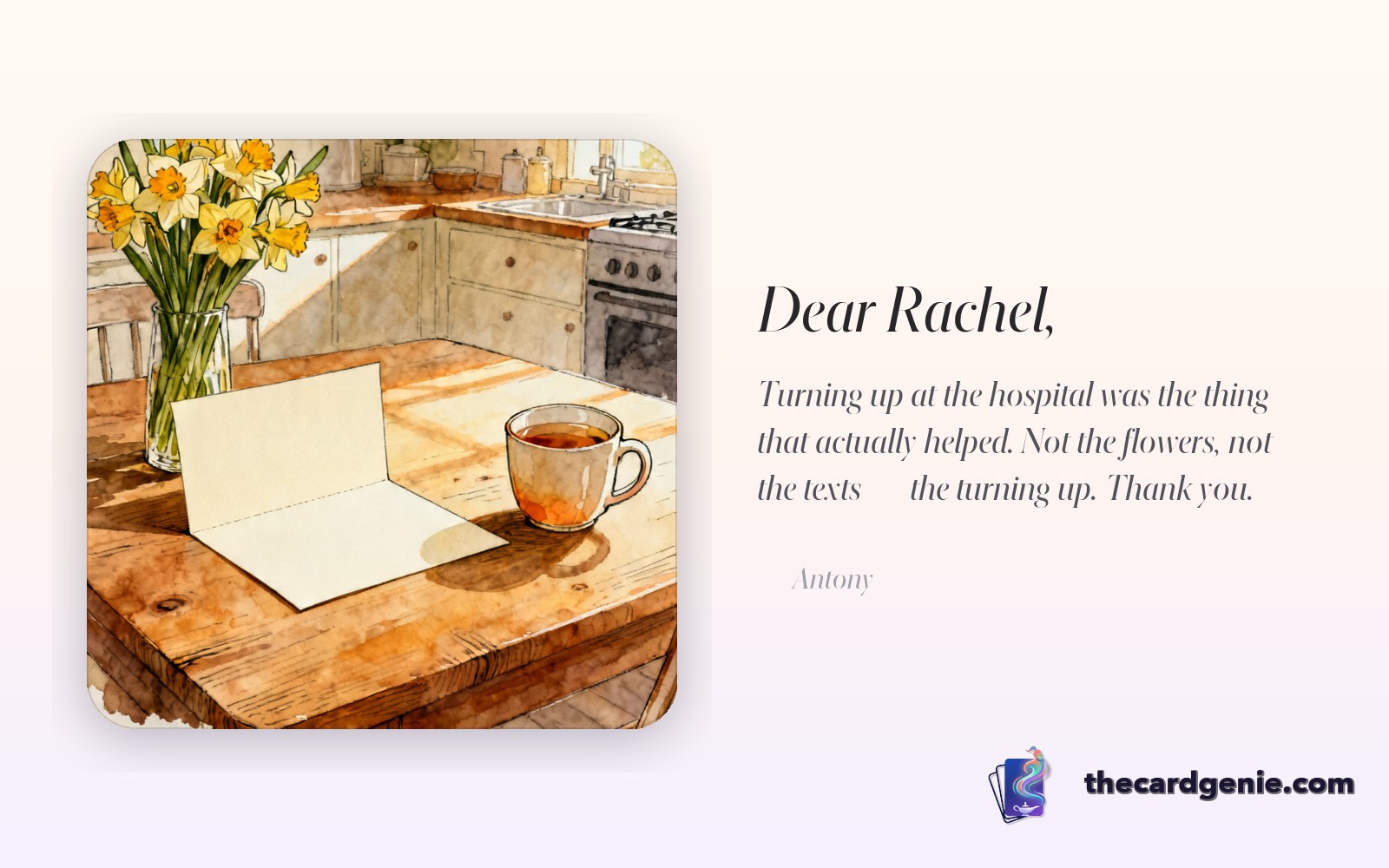
"Turning up at the hospital was the thing that actually helped. Not the flowers, not the texts, the turning up. Thank you."
For a host
"The weekend was exactly what we needed - the food, the house, the very specific wine you kept topping up. We left lighter than we arrived."
For a colleague who went above and beyond
"I know how much extra time that project took you. I noticed. Thank you - and lunch is on me."
For a teacher or mentor
"You told me one thing five years ago that I still think about every week. Thank you for that, and for everything that came with it."
For a neighbour
"We know how often you keep an eye on us without being asked. We see it. Thank you."
What to skip
- "Thanks for everything!" - means nothing.
- "You shouldn't have!" - they know.
- Overly formal language. It reads like a company email.
- Thanking them twice in the same sentence. Once is plenty.
Card ideas
1. The moment-they-helped card
Take the specific moment they showed up and build a scene around it. Airport pickup, hospital visit, rainy day with a broken-down car. "Watercolour scene of a lit-up car in the rain at 2am." It's an exact reference they'll get immediately.
2. The gift-in-use card
A stylised scene of the gift in use - the mug in your kitchen, the book on your bedside table, the dog wearing the jumper. Shows them the gift found its place.
3. The portrait card
Turn a photo of the person into a watercolour or storybook illustration. Feels like a keepsake. Hangs on a fridge.
4. The thank-you-video card
A short animated AI video card with a voice note of you actually saying the thank you. For people who've done something big, this works better than any written card.
5. The long-message card
If the favour was enormous and a short message won't cover it, use the long message field and write properly. Three paragraphs of specific gratitude reads better than a line of "thanks x1000".
When to send it
Within a week of the thing. A thank you card that arrives six weeks later still means something, but it carries a tiny undertone of "I'd forgotten." Within a week, it lands as a warm moment.
How to make one
Upload a photo, describe a scene, pick a style. The Card Genie builds it in under two minutes. Image cards from £1.79, video from £3.49. Cheaper than a box of M&S chocolates, more personal than anything on the rack.
Why thank you cards matter
People rarely get thanked for the small things. A card that names one specific small thing - the tea you made, the ride you gave, the ear you lent - makes the person feel properly seen. That matters more than the gift it's thanking them for, almost every time.