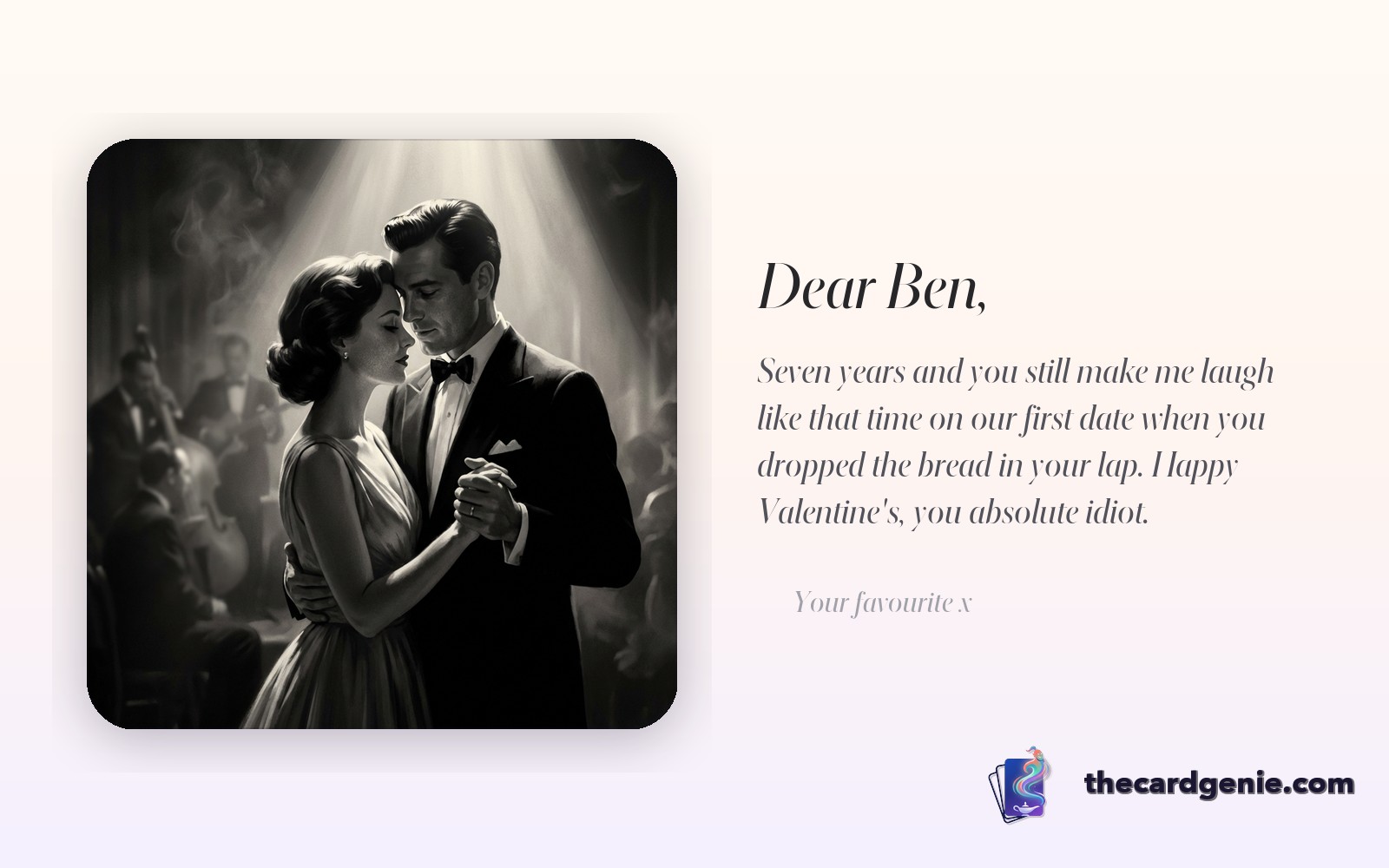
Valentine's Day cards are a strange thing. For one day a year, we're all expected to walk into a shop, pick a piece of card printed with someone else's idea of romance, and sign our name at the bottom. The person reading it knows we bought it that morning. We know they know. And yet we keep doing it.
There's a better way. Not a more expensive one. A more personal one. This is a guide to sending a Valentine's card that actually sounds like the two of you.
Why most Valentine's cards miss
The issue with shop-bought Valentine's cards is that they're written for a relationship in general, not your relationship. "To my one true love" is fine. It's also the same card 40,000 other people bought. The person you love doesn't want to be told something generic. They want to be told something only you could have said.
This is why inside jokes work so well on Valentine's cards. The half-finished phrase only they'd understand. The weird nickname. The thing that happened on your third date that you still laugh about. Those are the details that turn a card into a keepsake.
Turning a photo into the perfect scene
Here's where AI changes the game. Take a photo of the two of you, any photo, even a terrible one, and describe the scene you want it to become. The AI handles the rest.
A few combinations that work:
- Old Hollywood glamour. Black and white, velvet couch, martini in hand. Somehow this feels more honest than a stock heart illustration.
- A Parisian café. Even if the closest you've been to Paris is the Eurostar lounge.
- A 1950s jazz bar. Especially good if you went to one on your first date.
- A sci-fi space station. If your relationship is more "we laugh at the same dumb films" than "roses and poetry," this is the one.
The trick: pick a scene that matches your sense of humour together. Not the generic idea of romance. The specific thing the two of you find funny, or charming, or ridiculous.
Writing the message (without cringing)
Most people get stuck on the writing. A few quick rules that help:
- Don't try to summarise everything. Pick one moment you remember. One sentence is enough.
- Avoid the word "soulmate." It's not banned, it just isn't specific.
- Write it how you actually talk to them. If you normally text in jokes and abbreviations, a card written in formal English will feel strange.
- End with something forward-looking. "Can't wait for the summer" or "let's actually learn to cook this year" beats "forever yours" every single time.
If writing isn't your thing, let AI draft a first version and you can edit it into something that sounds like you. The draft is a starting point, not the final card.
Why video cards change Valentine's Day
The jump from an image card to a video card on Valentine's Day is bigger than you'd expect. A still is nice. A 10-second clip of the two of you walking hand in hand down a neon-lit street is a moment. A card you can play on a phone at dinner and watch someone's face light up is a completely different thing from handing over a folded piece of cardboard.
The bonus: you can record your own message in your own voice, and the card reads it back over a soundtrack. Their name, in your voice, in a card that looks like a film. The reaction is almost always the same. Silence, then a text to a friend.
How The Card Genie does it
We built The Card Genie for exactly this kind of thing. Upload a photo, describe the scene, write (or record) the message, and it's ready to send in under two minutes. Whatever you send, make sure it sounds like you. Valentine's Day cards only work if they couldn't have been written by anyone else.