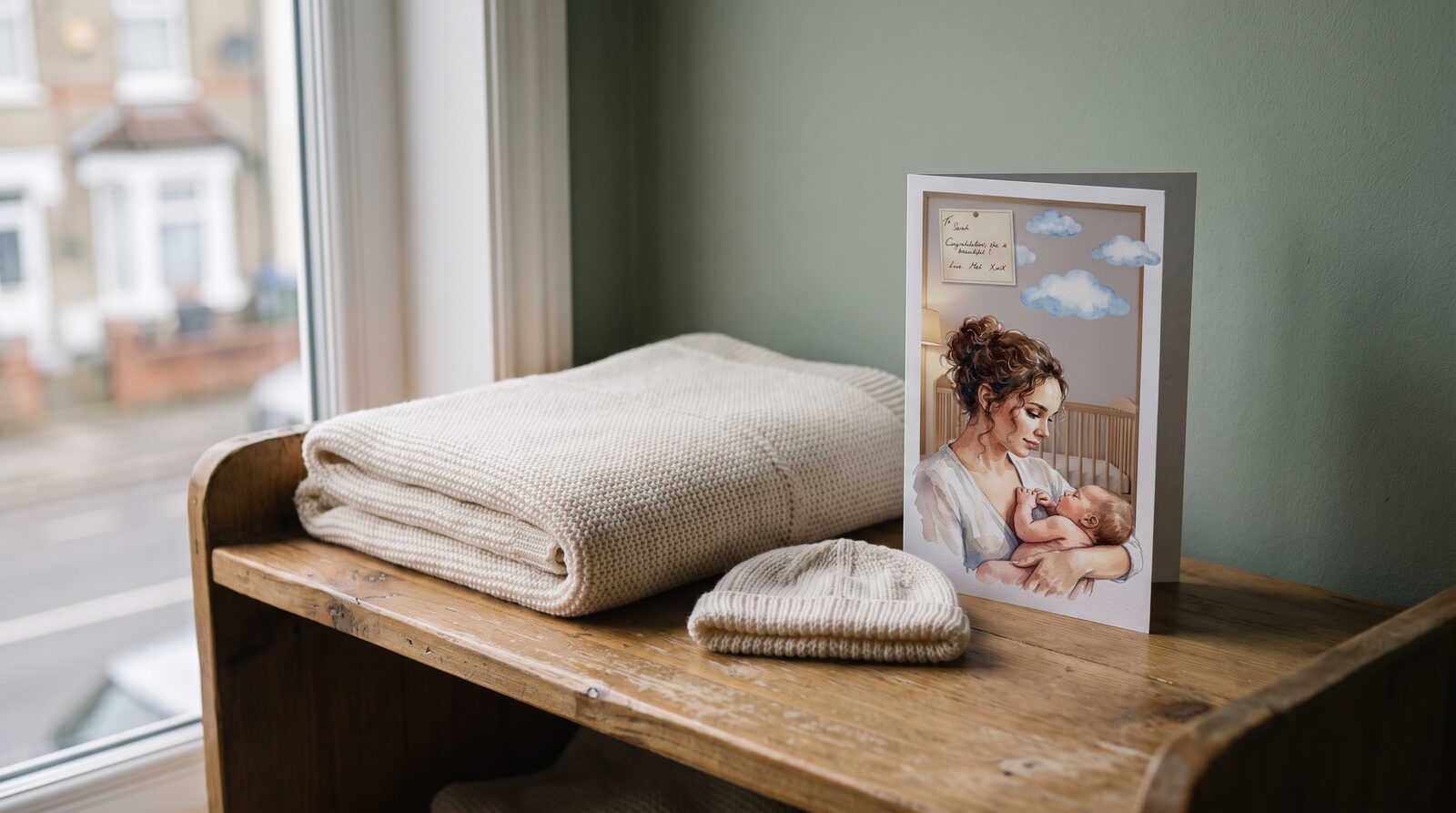
New baby cards have an unusual problem: the person who reads it is exhausted, emotional and holding something in one arm. Whatever you write will be read in about four seconds, probably twice, probably at 3am.
So the rule is even more ruthless than usual. Short. Specific. About them, not just the baby.
Write to the parents, not the baby
The commonest version of this card is addressed to a newborn, who cannot read, in a tone the parents will find slightly odd. "Welcome to the world little one!" is fine, and it is a card about nobody in the room.
The parents have just done an enormous thing. Say something to them.
- "Congratulations, both of you. What a week you have had."
- "Very well done. Not just to the baby. To you."
- "You are going to be so good at this, and it is going to be so hard, and both are normal."
- "Thinking of the three of you and hoping you are all getting some sleep, which I know you are not."
For a first baby
- "Everything is about to change and most of it is worth it."
- "Congratulations. Nobody knows what they are doing. Everyone says they do."
- "You will be brilliant at this. You have been practising on the rest of us for years."
For a second or third
Second-baby cards get forgotten, and the parents notice. Firsts get a mountain of cards; seconds get a fraction of it.
- "Congratulations on number two. This time you actually know what a Moses basket is for."
- "Two! Delighted for all four of you."
- "Congratulations. Sorry about the maths on the sleep."
- "Nobody sends a card for the second one. Consider this the correction."
That last one is a genuinely good message, and it will be noticed precisely because it names the thing.
For twins
- "Two at once. Extremely efficient and completely mad. Congratulations."
- "Congratulations. We are all quietly terrified on your behalf and enormously happy for you."
Avoid "double trouble". Everyone has already said it.
For an adoption
The arrival is the occasion. The route to it is not the subject unless they raise it.
- "Congratulations. So happy your family is complete."
- "Delighted for all of you. What a lucky pair you all are."
- "Welcome to the family. Congratulations to you both."
Do not use "your own", as in "like your own". They are their own.
After a difficult birth or a NICU stay
If you know it has been hard, acknowledge it once, briefly, and then be normal.
- "What a fortnight. Thinking of all three of you and so glad you are home."
- "Congratulations. And well done for the bit nobody puts on a card."
Do not ask questions in the card. They have answered enough of them.
From colleagues
Lower stakes and easy to get slightly wrong by being over-familiar.
- "Congratulations from all of us. Do not think about this place for a single minute."
- "Enormous congratulations. The team has been briefed not to contact you and I will enforce it."
That second one is a better gift than anything you could put in the envelope.
What to avoid
"Sleep now while you can!" They are past that. It is also the single most repeated line in this category and it lands as smug.
Predicting the future. "She'll be a heartbreaker" and "he'll be a footballer" are harmless and lazy, and a surprising number of parents dislike them.
Anything about the birth itself unless they have talked about it openly.
"Enjoy every moment." Nobody enjoys every moment, and the phrase quietly makes new parents feel they are failing when they are not enjoying it at 4am. "Enjoy the good bits, survive the rest" is truer and kinder.
Comment on who the baby looks like if you have not seen the baby. It is transparent.
When to send it
Not in the first week. Everybody sends in the first week.
Week three or four is better. That is when the visitors have stopped, the partner has gone back to work, the initial adrenaline has gone, and the days have become very long. A card arriving then is worth five arriving on day two.
If you want to mark the arrival immediately as well, something digital that lands the same day covers the announcement, and a printed card can follow when the noise has died down.
A card with a photograph on the front works well here in a way people do not expect: not of the baby, but of the parents, from before. A picture of the two of them on the front and "well done, both of you" inside is a card about the right subject.
You can upload a photo and describe the scene, and printed cards can be posted to them directly.
More across every occasion.