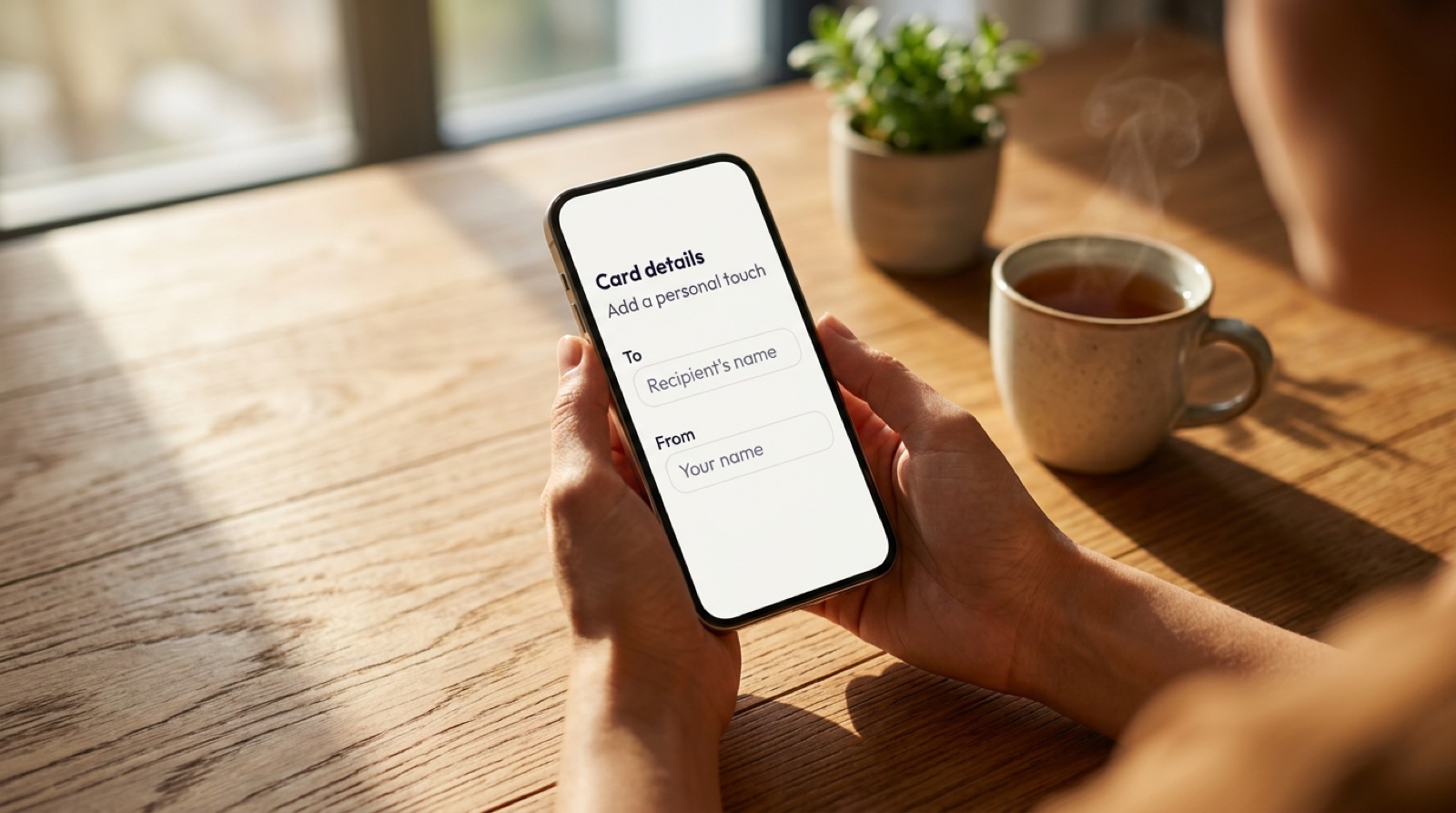
Nobody asks how long a card takes out of curiosity. They ask at 9pm the night before, or on a Tuesday having remembered something happening on Thursday. The question underneath is always the same: can I still do this in time, and which route gives me the best chance.
So here are the three routes people use, step by step: a shop trip, a print-and-post order, and a digital card.
Where these numbers come from, and where they stop
They are estimates of a familiar errand, not logged stopwatch runs, and they are rounded so nobody mistakes them for measurements. Anyone who has bought a card knows roughly what the walk, the rack and the queue cost, and that is the precision on offer: enough to compare three routes, not enough to quote back at us. Time your own if you want a real figure. You can, because these are the parts that belong to you.
What we have not estimated at all is anybody else's operation. No printer's dispatch window, no postal transit figure, no "usually arrives in" number for a company we do not run. Those move by season, service tier and day of the week, and the only figure that applies to your order is the one on that company's own checkout page when you place it. So where a competitor's number would normally sit, you will find an instruction: go and read it yourself, before you pay.
Route one: the shop
The clock does not start when you walk in, it starts when you decide to go.
- The gap between deciding and leaving. The biggest cost of this route, and never counted. Usually not minutes but a day or two of "I will do it tomorrow".
- Getting there and back. Ten minutes each way at best, considerably more once a car park is involved.
- The rack. The best part of ten minutes, because you will read four verses about "a special someone" before finding one that is nearly right.
- Queue and pay. A few minutes, at the mercy of whoever is in front of you.
- Writing it. A couple of minutes if you know what to say. Far longer if you do not.
Door to door: most of an hour of clock time, and a much larger amount of day. And that only finishes the job if you are handing it over in person. Otherwise the trip has bought you an object, not a delivery. You still have to find a postbox, check the collection time on the plate on the front, and then wait out the postal leg, which is not a number we are going to invent for you.
Where the shop genuinely wins. If you are seeing the person today, nothing beats it. No account, no upload, no phone. You hand over a physical thing and watch their face, which is the entire point of a card. If you enjoy the browse, the rack is the nice bit rather than lost time. And you can buy one for cash without giving anybody your email address.
Route two: print and post
Your hands-on time is short and pleasant. Choosing a design, typing the message, uploading a photo, checking out: a quarter of an hour or so on the sofa, no shoes required.
Then the clock leaves your hands entirely, and two things catch people out:
- A dispatch date is not a delivery date. Check which of the two you are being shown, because the gap between them is where a card ends up arriving on the Monday after the birthday.
- The order cut-off is a real deadline. Find it before you start, and read what the site says happens to orders placed after it, especially one landing before a weekend.
Look both up on the site you are ordering from, on the day you order. Not from a blog, not from a forum, not from what happened last Christmas.
Where print and post genuinely wins. You get an object. It sits on a mantelpiece, goes in a memory box, survives a phone upgrade and a switched WhatsApp account. For someone who does not really do links, a card in an envelope is the better gesture, and it feels like a present rather than a message.
Route three: digital
Almost all of this total is you, not the software.
- Choosing the photo. A few minutes, and the real bottleneck. Everybody scrolls their camera roll twice.
- Describing the scene you want. Under a minute. One line is enough.
- Making the card. About two minutes for the genie to build it, which you spend putting the kettle on.
- Looking at it and deciding. A minute or two, because you will want to show someone.
- Paying and sending. Under a minute, by WhatsApp, email or a link.
Under ten minutes including the dithering. But the number that matters is not ten minutes, it is that the sending is the delivering. No leg of this journey belongs to anyone else's van, which is why it is the only route where "can I still do this today" has a guaranteed answer.
Where digital genuinely loses. They have to look at their phone, and a card dropped into a busy group chat can scroll away, so send it directly. It is also not a physical object, which for some people and some occasions matters more than anything else here. If you want both, the printed add-on is £4.49: a card carrying a code that plays the animated version when scanned, posted in a blank envelope, to your address or theirs. That is a separate errand with its own timeline, so it sits outside this comparison.
The comparison that actually matters
Total minutes is the wrong scoreboard. The question is what proportion of the timeline you control.
- Shop: most of it is yours, right up until it needs posting, at which point none of it is.
- Print and post: a small slice is yours. The rest belongs to a printer, a sorting office and the calendar.
- Digital: all of it is yours, start to finish.
That difference only becomes visible when you are late. With three weeks in hand every route works and you should pick on feel. With two days in hand, only one has a timeline you can plan around.
None of them removes the ten minutes in the middle, deciding what to write. No format fixes that.
So how late can you leave it?
Seeing them today, go to the shop, because nothing beats handing it over. Not seeing them and it has to land on the day, go digital, because nothing in that chain is outside your control. Want a physical object with lead time in hand, order print and post, having read the cut-off and the delivery estimate on the checkout page first.
How it works walks through the digital version in about a minute, or you can make one and time it yourself. Image cards are £1.79, a five second animated one with sound is £3.49, and every design gets a free preview.
FAQs
Which is quickest: a shop card, a posted card or a digital one?
Digital, but only because it is the one route with no handover at the end. The others can be quick to start and still land late, because most of their timeline belongs to a postbox, a printer or a sorting office. Judge a route by how much of its clock you control, not by how fast it starts.
Is it too late to send a card the day before?
Not for a digital one. That is the entire case for it: making it and sending it are the same action, so there is no transit leg to run out of. For a posted card it depends on the cut-off time and delivery estimate on the site you are ordering from. Check both before you pay.
Are digital cards worse than posted ones?
They are different, and it depends on the person. A posted card is an object that gets kept on a shelf, and for someone who does not live on their phone it is the better gesture. A digital one is more personal in content and lands on the day from anywhere. Judge it by the recipient, not the format.
How do I know whether a posted card will arrive in time?
Read the checkout page of the site you are buying from, on the day you buy. Check whether the date shown is a dispatch date or a delivery date, check the cut-off time, and note whether the estimate counts working days, because a Friday order and a bank holiday can quietly move it. Any figure quoted anywhere else, this page included, is not about your order.