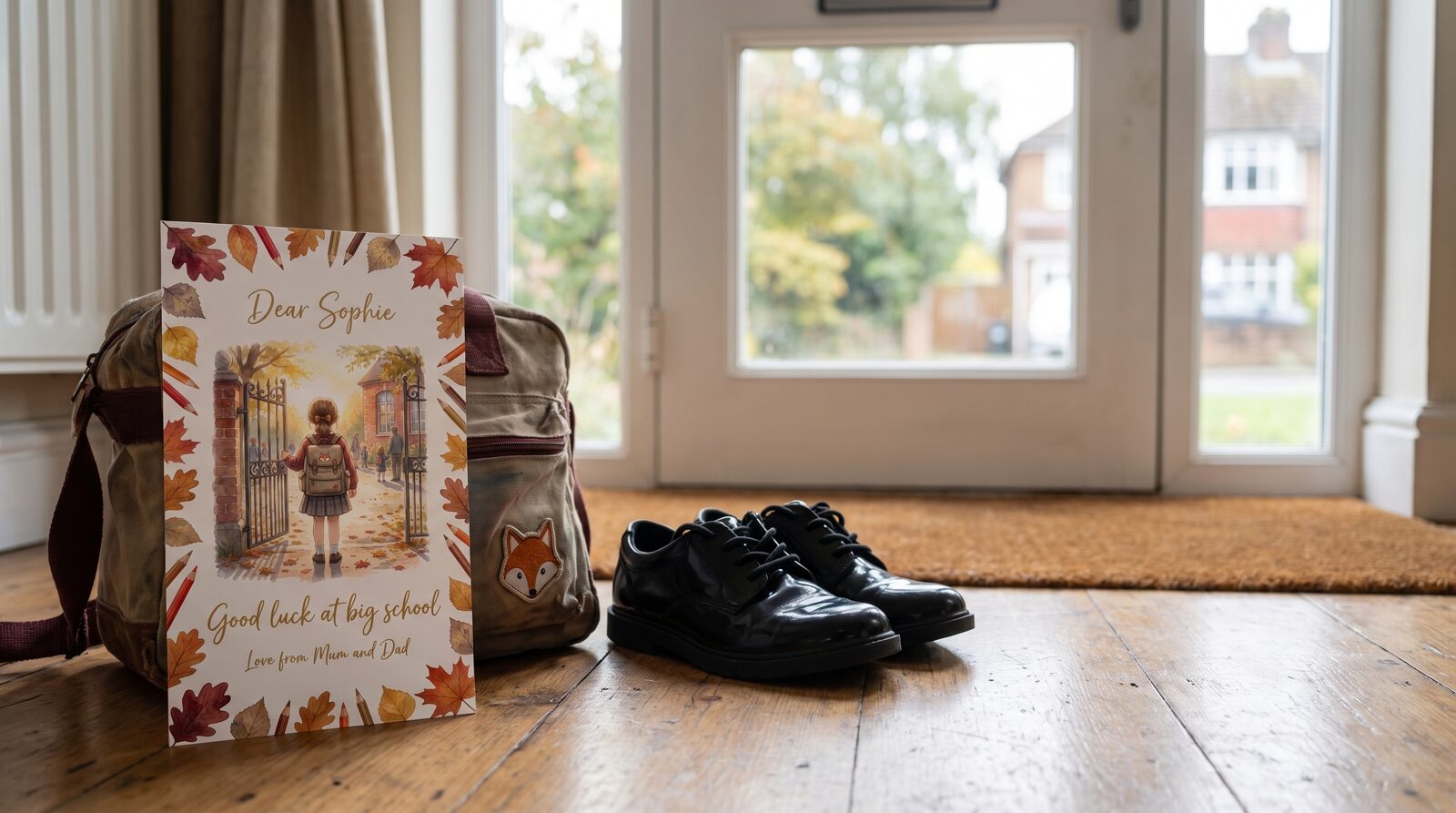
The photograph on the doorstep is the tradition everyone knows about. The card is the better one, because it can be read again in February when the novelty has worn off and school has become simply a thing that happens every day.
Two very different cards here, so this splits into two.
Starting reception (four and five year olds)
They cannot read it. That is not a problem, it is the format. Somebody will read it to them, probably more than once, and what you are really writing is a script for that adult.
Keep it to one or two sentences. Concrete nouns. No abstractions.
- "Today you are starting school. You are going to meet your teacher and you are going to have a peg with your name on it. We will be right outside at home time."
- "Big day! Remember: you can always ask. Asking is the clever thing to do."
- "Have a brilliant first day. Mummy will be at the gate before you know it."
- "You are going to be so good at this."
The single most useful line you can put in a reception card is a promise about pick-up, because that is the only part they are actually worried about. Everything else is adult anxiety.
Avoid: anything about making friends. It sounds encouraging and it plants a job they did not know they had. Four-year-olds make friends by standing near each other. Do not make it a task.
Starting secondary school (Year 7)
Completely different animal. They can read, they are self-conscious, and they will be mortified if the card is babyish. They will also read it privately about six times.
- "First day at big school. Nobody there knows what they are doing either, including the ones who look like they do."
- "You do not have to be anyone new. The old one was good."
- "Getting lost on the first week is compulsory. Everybody does it. It is fine."
- "Whatever happens today, you are coming home to the same house and the same dinner."
- "New school, new subjects, same brilliant brain."
The most valuable thing in a Year 7 card is permission to find it hard. They have spent the summer being told it will be great. Almost every eleven-year-old privately suspects they are the only one who is nervous.
- "It is completely normal for the first few weeks to be a bit rubbish. It gets better fast."
That one sentence does more than a page of encouragement.
From grandparents
Grandparents are unusually good at this, because they are one step removed from the anxiety.
- "Your dad cried on his first day too. Ask him about it."
- "I went to school in a building with outside toilets. You will be fine."
- "There is a pound in this card. Do not tell your mother."
From a godparent, aunt or family friend
Lower stakes, so this is where you can be funny.
- "Good luck. Learn something. Ignore most of it."
- "Enjoy the first day. Enjoy the last day more. Everything in between is negotiable."
- "New shoes, new bag, new start. Go on then."
Practical notes
Give it the night before, not the morning. The morning of a first day is chaos and nothing gets read properly. The night before, in bed, is when a card actually works.
Do not put money in a reception card if it is going into the bag. Bags get emptied on the floor by twenty-nine other children.
If they are anxious, write the card to be re-read. Say explicitly that they can look at it again. Some children take a card into school in a pocket, which is the whole point.
For teachers, at the other end of it
If you are here in September looking for the teacher version, that is a different card and it belongs at the end of term rather than the start. What to write in a card for a teacher covers it.
A card with their photograph on the front, in a scene they picked, tends to get kept in a way a shop card does not. You can upload a photo and describe the scene in a couple of minutes, and have a printed copy posted to you for the night before.
More ideas across every occasion.